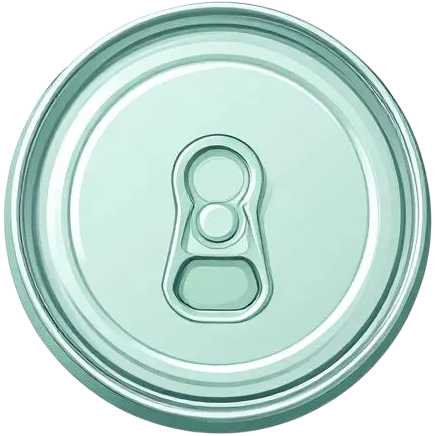
Meet the cansultants
Every canclusion uses the same rubric: five criteria, 0-to-10 integer sub-scores, and one weighted decimal at the end. The cansultants argued over the criteria, weights, and anchors until the rules felt worthy of a crushed can. Then the vision model applies those rules to your photo. Same photo, same score, every time.

The cansultants
- The cantainment-and-flatness purist — believes a clean circle tells you everything.
- The seal-and-symmetry absolutist — a flush pull-tab over an open aperture is not a closed seal, and they will not be moved on this point.
- The aesthetic committee — they don't agree.
The criteria
Each criterion gets its own 0–10 integer score. The anchors below are the rules of engagement.
Cantainment
40%How well the crushed can keeps its material gathered around the original cylinder footprint. Cantainment is the most demanding criterion — preserving the cylinder's structural integrity through a crush is the hardest part of the craft. Visible compressed sidewall or label material is normal on a real crush, and a cantained can can look taller because the material stayed stacked instead of sprawling outward. Score cantainment by how tightly the folded body remains attached around the visible lid/rim, not by whether every edge is a mathematically perfect circle.
- 10Perfect circle. The crushed can's outline traces a clean circular shape with no flare, no asymmetric extension, no material protruding past the circle on any side.
- 7-9Cantained. The lid/rim remains the clear center of one coherent crushed body; folded sidewall may form a lumpy, square-ish, or uneven band, but the material stays tightly gathered around the original footprint.
- 4-6Partly uncantained. A clear wing, flap, or broad flare extends well beyond the lid/rim, but the can still reads as one coherent crushed body.
- 1-3Mostly uncantained. Severe splay: material sprawls far beyond the lid/rim, separates into large uncontrolled extensions, or the cylinder form is mostly lost.
- 0Completely uncantained. The can has burst, shredded, or flattened with no coherent resemblance to its original cylindrical form.
Seal
15%How closed the can's drinking aperture (the oval slot cut into the lid near the rim) is after the crush. Pull-tab position is NOT seal — the tab is the lever that opens the aperture, but the aperture itself is what's being scored. The pull-tab's finger hole and rivet are not the drinking aperture. A 0 requires a clear view of a fully open, unaffected lid aperture; when glare, shadow, angle, or the tab obscures the aperture, score the visible evidence and lower confidence instead of inferring 0.
- 10Aperture fully crushed shut; no opening visible at all.
- 7-9Aperture mostly closed; small slit, sliver, or pinhole visible.
- 4-6Aperture partially closed; opening reduced but clearly present and visible.
- 1-3Aperture largely open; original opening shape mostly intact.
- 0Aperture unmistakably fully open and unaffected by the crush.
Symmetry
15%How level the crushed can's top face sits relative to the ground. A perfect-symmetry crush has the top face parallel to the surface — no high side, no low side, no wedge. Tilt or wedge-shaped crushes (one side notably higher than the other) score lower.
- 10Top face perfectly level with the ground; no visible tilt or wedge.
- 7-9Mostly level with minor tilt; one side slightly higher than the other.
- 4-6Visibly wedged; one side notably higher than the other, with a clear high and low side.
- 1-3Strong wedge or tilt; the can is closer to leaning than lying flat.
- 0Effectively on its side; the 'top' is no longer the highest face of the crush.
Flatness
20%How thoroughly compressed the can is, evaluated against the practical cantained-compression limit. Flatness is paired with cantainment, but it is not the same as cantainment: a can can be very flat even when it is flared or ugly, and a highly cantained can will inevitably show some remaining height because the material stayed cantained. A high-cantainment crush at its limit scores flatness 9–10 even with visible sidewall height. Low-cantainment crushes score high when the body has collapsed into a thin puck, slab, or pancake.
- 10At the practical compression limit. For high-cantainment crushes (cantainment 8+), this is visible but minimal remaining height. For low-cantainment crushes, the body is near-pancake.
- 7-9Heavily compressed; the can reads as a thin puck, slab, or pancake with little upright height remaining.
- 4-6Moderately compressed; meaningful work done but more compression was clearly achievable.
- 1-3Lightly crushed; most original height remains.
- 0No meaningful compression.
Aesthetic
10%Overall craft and visual pleasingness — the model's judgment.
- 10Beautiful, intentional, satisfying form.
- 7-9Nice looking; minor blemishes.
- 4-6Unremarkable.
- 1-3Ugly, jagged, or sloppy.
- 0Mangled beyond aesthetic merit.
The math

Your overall score starts as a weighted average of the sub-scores, rounded to one decimal place with half-up rounding. If the same image comes back later, we reuse the cached score by pixel hash, scoped to your account or session.
Then cantainment gets its moment. It is the hard part: keeping the cylinder's circular footprint while still actually crushing the can. Once a real crush reaches cantainment 8 or higher, any meaningful compression at all, it puts a floor under your overall: 8.0 at cantainment 8, 9.0 at cantainment 9, and 9.5 at cantainment 10. Nail the circle and the grace notes can't drag you below it.
There is also a mercy rule for the almost-nailed-it cases. If cantainment is at least 7 and flatness is at least 8, the overall can't land below 9.0. A near-cantained, genuinely flat crush gets credit for the craft even when the seal or polish is imperfect.
The tiers
The cansultants turn the decimal score into one of five named tiers. The number matters. The tier is the line you remember.
- 9.5–10.0 Canonized
- 8.0–9.4 Cancluded
- 5.0–7.9 Holding form
- 2.0–4.9 Decanstructed
- 0.0–1.9 Discancled
Verdicts
- Cancluded. The model is confident in the read.
- Low confidence. The model produced a score, but the photo is on the edge. Cleaner lighting or framing will get you a tighter read. (Triggered when confidence falls below 0.6.)
- Inconclusive. We can't score the photo: wrong angle, no can detected, multiple cans, blur, or obstruction. Try another shot.
What we don't do
- Every canclusion uses the same canonical scoring rules.
- We don't train models on your images.
- We don't lock your old canclusions behind a paywall.